
Customer Case: Ring Main Unit Secondary Assembly Line, Secondary Production Line, and Robotic Welding Workcell
In the switchgear and power equipment industry, buyers do not choose a project only because of one machine. They choose a complete production method that can run steadily, stay manageable, and support long-term delivery. A ring main unit, a gas tank assembly area, secondary wiring, welded structures, and inspection stations are all closely connected. If the front-end rhythm is unstable, the testing area will be blocked. If welding quality varies, later assembly will repeat the same rework. If material flow is unclear, the workshop will slowly depend on manual memory instead of process discipline.
This case brings together a ring main unit secondary assembly line, a ring main unit secondary production line, a ring main unit secondary assembly production line, and a robotic welding workcell. The goal is not only to show what the workshop looks like, but to explain how a real B2B manufacturing project should be organized when the customer needs batch output, safe operation, stable quality, and a professional factory presentation.
Taizhou Yufeng Intelligent Equipment Co., Ltd. was founded on December 5, 2019. The company focuses on automation production lines, custom automation equipment, conveyor systems, inspection fixtures, and turnkey line delivery. For overseas buyers and domestic manufacturers, a mature solution is not only about whether the equipment can work. It is about whether the line can work at takt time, whether different shifts can produce the same result, and whether the factory can keep the same level of quality over time.
Project background: why ring main unit production needs a system upgrade
Ring main unit manufacturing is different from ordinary part assembly. It combines structural positioning, box body assembly, welding, secondary wiring, inspection steps, and strict safety requirements. Many factories face the same problem during capacity expansion: more equipment does not automatically mean a better line. More workers do not automatically mean better quality. Each station may work alone, but when the stations are connected into one system, cycle time and coordination may become unstable.
The customer usually cares about four things. First, can the line support continuous batch production? Second, is the process clear enough for new operators to learn quickly? Third, is quality controllable from welding to final inspection? Fourth, does the workshop look organized enough to present to overseas customers, partners, and visiting teams? This project was designed to answer all four questions at the same time.
Station 1: secondary assembly line rhythm and layout
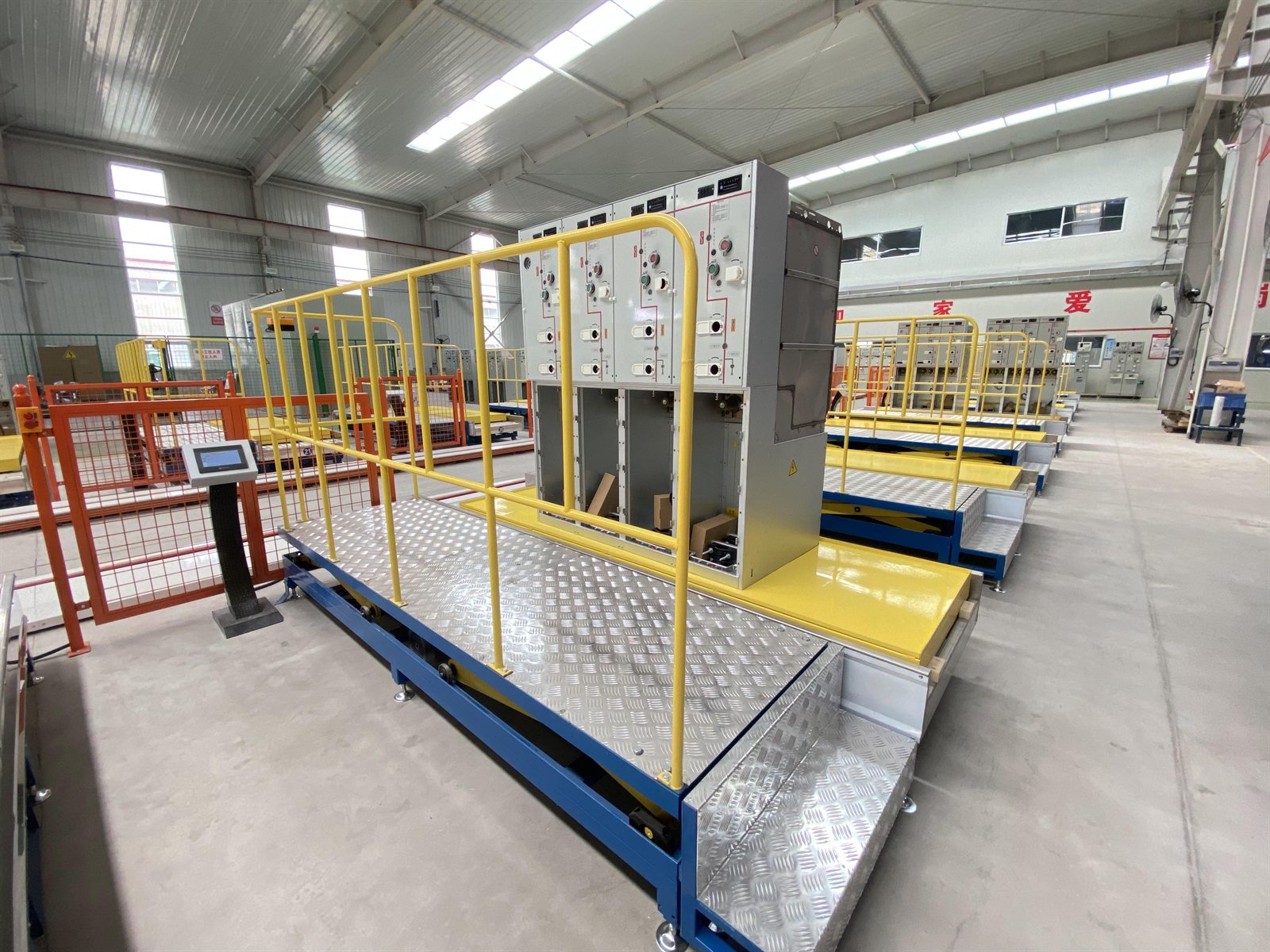
The first photo shows a compact but well-structured secondary assembly area. The platform, guardrail, control cabinet, and material path are separated in a way that keeps movement simple and clear. Operators can work within a defined zone without constantly walking back and forth between machines. That matters a lot in switchgear production, because assembly work should be repeatable, not improvised.
The key point in a secondary assembly line is not to fill every inch of the workshop. The key point is to arrange the stations in a logical sequence. In this project, each station can be understood as a specific action: positioning, fastening, assembly, confirmation, and transfer. When the process is organized this way, the manager can read the line status at a glance, operators know the next step, and quality inspectors can quickly identify where a problem began.
Station 2: secondary production flow and material transfer
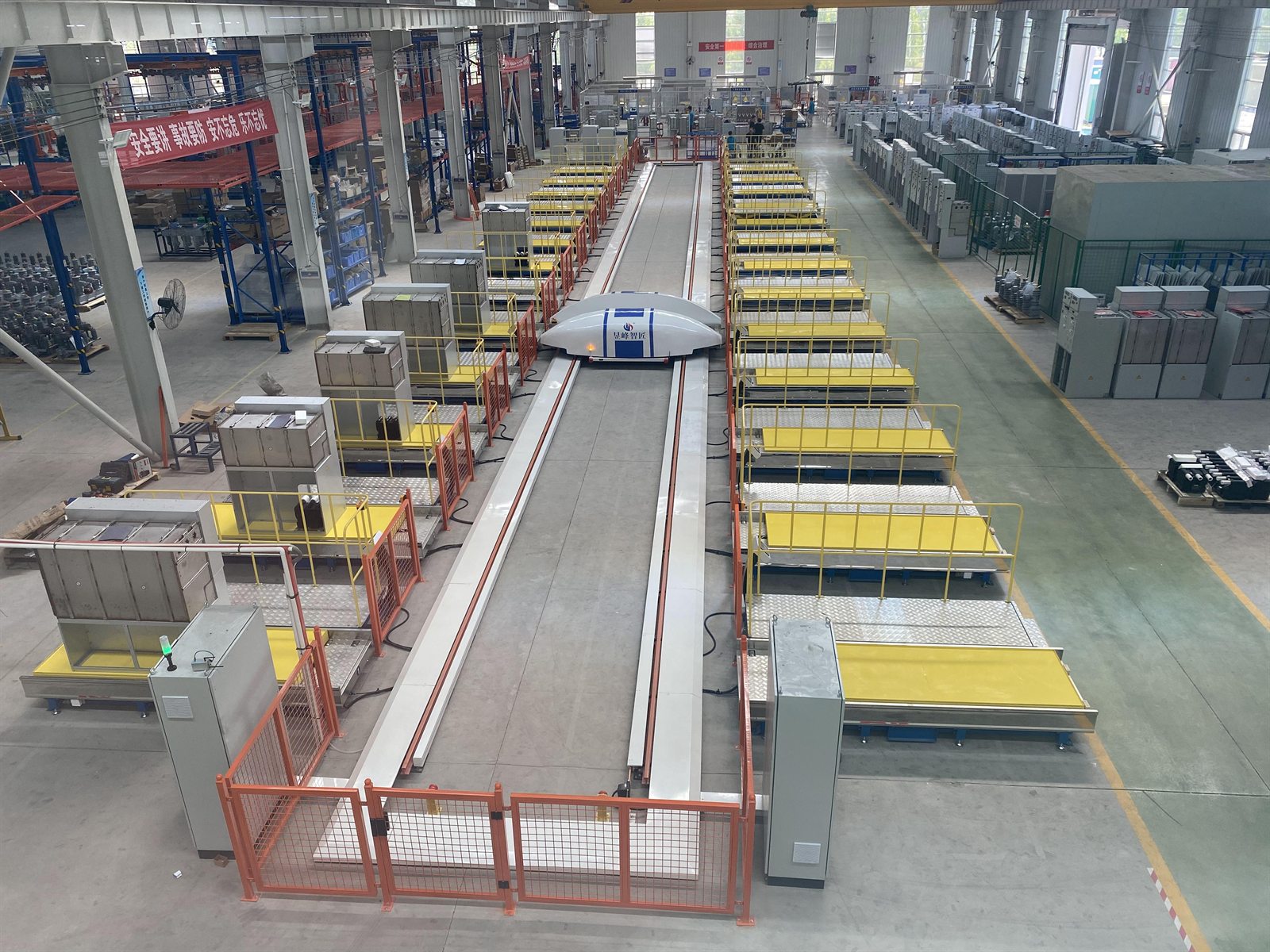
The second photo gives a wider view of the secondary production line. From this angle, the workshop shows a strong ?continuous flow? logic. Multiple stations are arranged along both sides of the main path, while the center lane stays open for movement, inspection, and maintenance access. For electrical equipment factories, this separation is important because the workshop must not only produce, it must also support ongoing checks and adjustments.
The main challenge in a secondary production area is not the station itself, but the connection between stations. A line often looks fine when each step is viewed separately. Once wiring, installation, checking, labeling, and transfer are linked together, the rhythm can become unbalanced. Our approach is not to force every station to move at exactly the same speed. Instead, we use clear station ownership, buffer logic, and simple transfer rules to keep the line stable.
Material control is equally important. Labels, wire sets, mounting parts, and fastening items need to be prepared in advance. If the operator has to search for parts during the job, time is wasted and mistakes become more likely. In this project, the material relationship between stations was kept simple and readable, so operators could focus on the work instead of hunting for parts.
Station 3: secondary assembly production line and overall layout
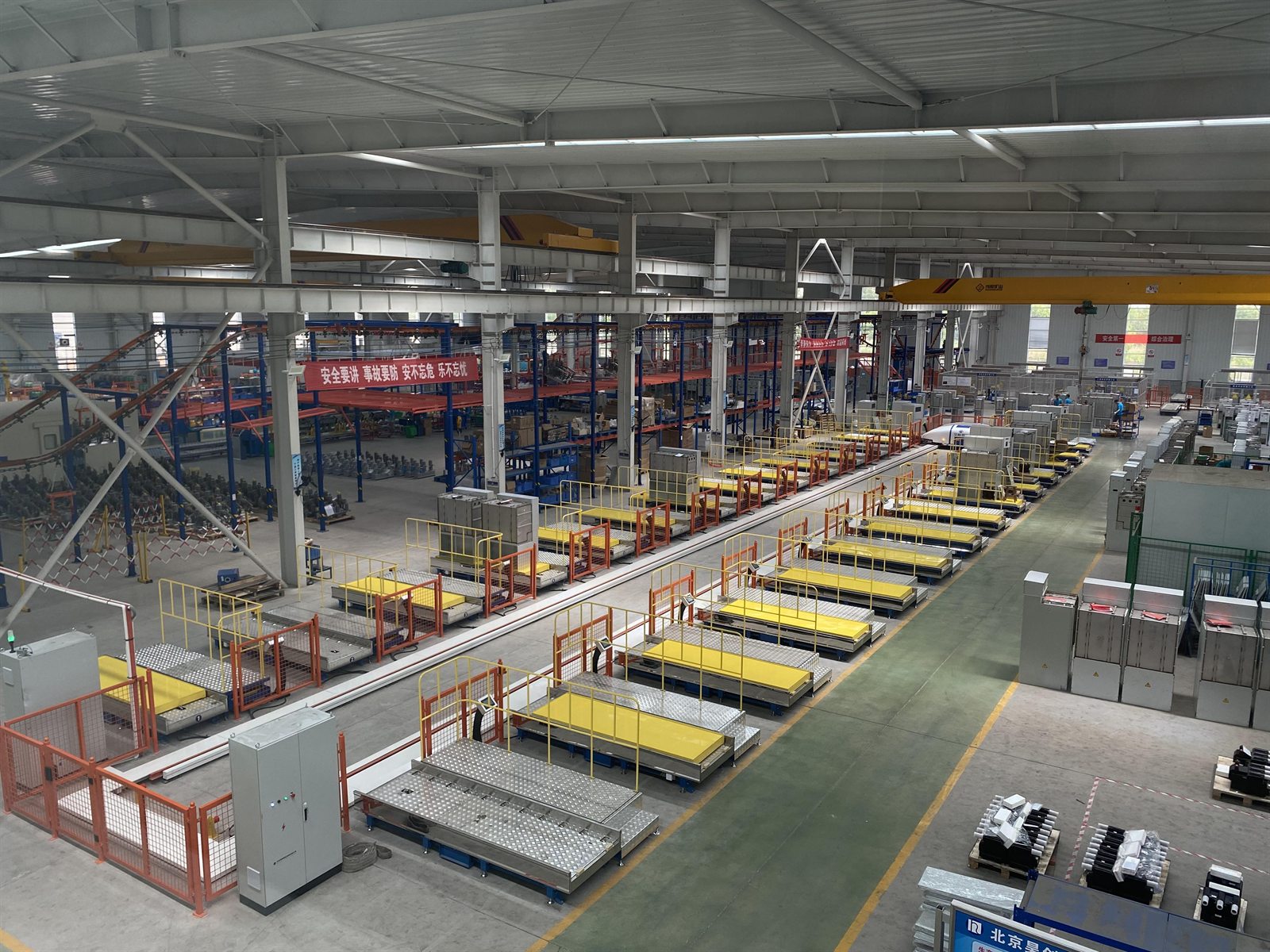
The third photo shows the full workshop layout more clearly. The line has a strong production direction from front to back and from left to right. Platforms, fences, inspection equipment, main aisles, and side aisles are separated in a way that improves both safety and visual order. For cross-border manufacturing customers, this matters because overseas buyers usually form an opinion very quickly when they enter a factory. They may not read a long proposal first. They look at the workshop.
A mature secondary assembly production line should work on three levels: the action level, the management level, and the presentation level. The action level answers how people work. The management level answers who is responsible for what, when each step should move forward, and where confirmation is required. The presentation level answers how visitors can understand the process without disturbing production. In this project, we kept the key stations visible while still protecting the working area from unnecessary crowding.
Safety was also a major design topic. Guardrails, anti-slip surfaces, boundary colors, passage width, and control positions were all arranged to be easy to understand. A factory is not a showroom, but a good production line should still make it obvious where people can walk, where they cannot enter, where the working area is, and where the waiting area is. Clear boundaries are part of process discipline.
Robotic welding workcell: turning unstable manual actions into stable capability
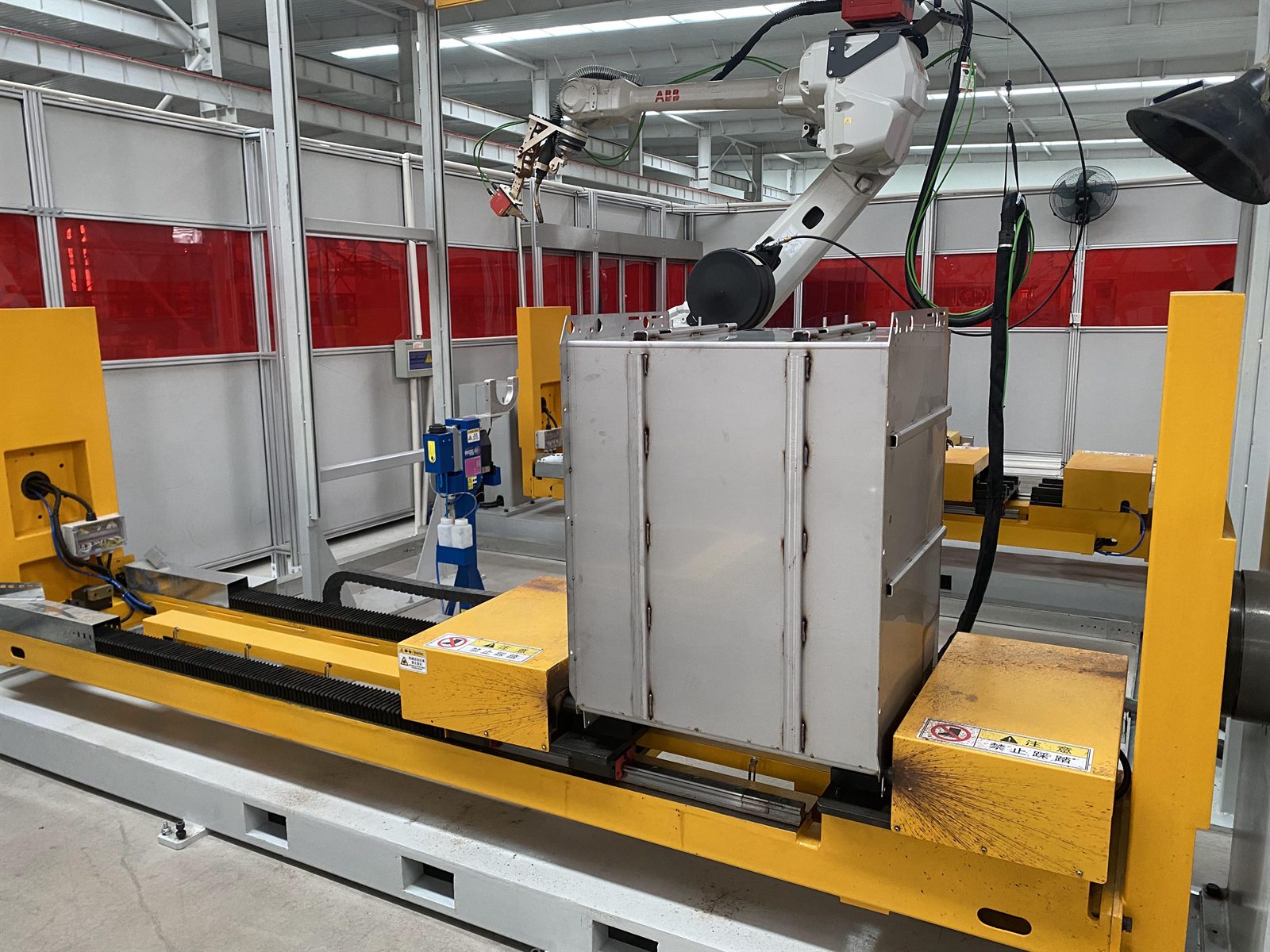
The fourth photo shows the robotic welding workcell. For ring main unit related structures, welding quality directly affects assembly accuracy, surface condition, and overall consistency. Manual welding can complete the task, but when order volume grows and multiple product models run in parallel, welding rhythm can become uneven and rework can increase. The value of a robotic workcell is to convert experience-based work into a process that can be repeated, checked, and traced.
For this workcell, we focus on three points. First, welding posture must remain stable. Second, the fixture must locate the workpiece reliably. Third, the transfer after welding must be smooth. Many buyers think robotic welding is only about automatic torch movement, but the real success factor is whether the upstream and downstream process flows are coordinated. If loading is awkward, the fixture is weak, or unloading is unclear, the robot will not solve the overall takt problem.
That is why the welding station is not isolated. It is part of the whole secondary production line. Its role is to provide a more stable part base for the next assembly and inspection steps, so the assembly area has fewer rework cases, the inspection area sees fewer exceptions, and the final delivery becomes easier to manage.
Quality control: fixtures, process, and delivery records
The real value of a project like this is not how good it looks on day one. The real value is whether it still runs the same way after three months or six months. To make that happen, we usually divide quality control into several layers. The fixture layer ensures accurate positioning. The process layer ensures every action has a sequence. The record layer makes it possible to trace problems. The delivery layer gives the customer not only the equipment, but also the operating logic, maintenance habits, and technical files.
For power equipment factories, records are especially important because different batches, shifts, and operators will always introduce variation. The only way to keep stability is to lock in the key steps and define clear checkpoints. In this case, we would recommend confirmation points between secondary assembly, secondary production, and welding, including pre-check, post-weld inspection, transfer confirmation, and final visual inspection.
Delivery result: a factory that can produce and present itself well
Many factories focus only on output and forget that a factory also has to present itself. Buyers, agents, audit teams, and partners all enter the workshop, and what they see is not only capacity but also organization, standardization, and growth potential. That is why we always design for both ?running well? and ?looking professional.?
The result of this project can be summarized in four words: clearer flow, steadier action, cleaner layout, and easier communication. Internally, operators learn faster, managers inspect more easily, and maintenance staff locate issues faster. Externally, visitors can understand the process quickly and trust the factory more easily.
If your factory is planning a ring main unit secondary assembly line, a secondary production line, a robotic welding workcell, or a similar power equipment manufacturing project, you can send product drawings, sample photos, target output, workshop dimensions, and current process videos to us. We will build a practical solution that supports long-term manufacturing rather than a line that only looks busy in photos.
A production line that works well is not one that has the most equipment. It is one where every station knows exactly what to do.
Closing
This project once again shows that ring main unit manufacturing is a good fit for a combined layout of assembly line, secondary production line, and welding workcell. When the process logic is clear, station relationships are reasonable, and quality checkpoints are defined, the factory not only improves efficiency but also presents its manufacturing capability in a more trustworthy way. Taizhou Yufeng Intelligent Equipment Co., Ltd. will continue to support this kind of project with layouts that are more stable, easier to manage, and easier to present to global buyers.